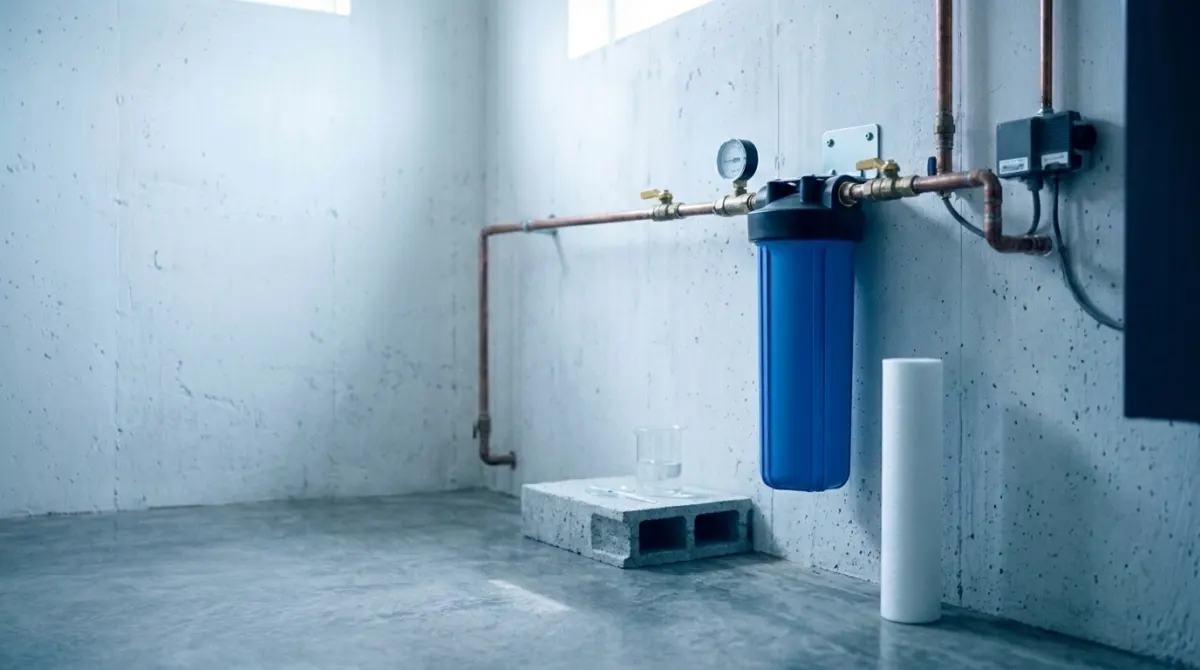
Updated June 2026 · 14 systems considered, 3 survived
Whole-house water filter systems compared,
with the math shown
Most 'best of' lists rank whoever pays the highest commission and pad the page with ten systems nobody should buy. We cut to the three worth your money — and tell you which one fits YOUR water, because that's the only question that matters.
By Tim Parker — Reads the spec sheets and prices the full install
The short answer
On city water, buy the SpringWell CF1: a 1,000,000-gallon catalytic carbon system that holds 9 GPM of service flow in its smallest size, so your showers don't notice it exists. On well water, carbon isn't your first problem — iron and sulfur are, and that takes the WS1 air-injection system instead. The famous Aquasana Rhino is a fine system trapped behind a ~7 GPM flow ceiling that larger households will feel at 7 a.m.
Top pick — city water
SpringWell CF1 Whole-House Carbon System
- Best for
- Chlorine, taste & odor, 1–3 bath homes
- Real installed cost
- $1,170–$1,900
- Spec that decides it
- 1,000,000-gal media life
Top pick — well water
SpringWell WS1 Air-Injection Iron Filter
- Best for
- Iron staining, sulfur smell, manganese
- Real installed cost
- $2,250–$3,000
- Spec that decides it
- Handles 7 ppm iron, 8 ppm H₂S
The famous one
Aquasana Rhino EQ-1000
- Best for
- Light-duty city water, smaller homes
- Real installed cost
- $1,123–$1,900
- Spec that decides it
- ~7 GPM flow ceiling
Best for combined problems
SpringWell CF+SS Combo System
- Best for
- City water with hardness — filter + soften in one install
- Real installed cost
- $2,250–$3,000
- Spec that decides it
- One install visit vs two
Certified PFAS layer
Aquasana SmartFlow Reverse Osmosis
- Best for
- PFAS-focused households — kitchen tap
- Real installed cost
- $200–$550
- Spec that decides it
- Certified PFOA/PFOS reduction
Multi-media well water
Crystal Quest SMART Whole-House Filter
- Best for
- Complex well water, heavy metal concerns
- Real installed cost
- $1,790–$2,600
- Spec that decides it
- KDF-55, KDF-85, GAC multi-stage
High-efficiency tankless
Waterdrop G3 P800 Tankless RO
- Best for
- Under-sink RO — fast tankless, broad reduction
- Real installed cost
- $849–$1,150
- Spec that decides it
- 800 GPD, 3:1 pure-to-drain
Budget whole-house
iSpring WGB32B 3-Stage Whole-House
- Best for
- Budget city water on free chlorine
- Real installed cost
- $378–$900
- Spec that decides it
- 15 GPM, 100,000-gal cartridge set
How the three compare on the specs that decide it
| Spec | SpringWell CF1 | SpringWell WS1 | Aquasana Rhino |
|---|---|---|---|
| Built for | City water (chlorine, taste, odor) | Well water (iron, sulfur, manganese) | City water, light duty |
| Media life | 1,000,000 gallons | Air-injection bed, periodic regeneration | 1,000,000 gallons / 10 yr |
| Service flow | 9 GPM (1–3 bath size) | 12 GPM rated | ~7 GPM published |
| Typical street price | $1,170 | $2,250 | $1,123 |
| With pro install | $1,450–$1,800 | $2,250–$3,000 | $1,300–$1,600 |
| Verdict | BUY — city water | BUY — well water | Situational |
What a whole-house filter costs installed
The system price is only part of the number. Add installation labor, and for some systems, the cost of a bypass valve assembly, new shutoff valves, and drain connections if your existing plumbing needs updating.
| System | DIY-installed | Pro-installed (typical) | 10-yr total |
|---|---|---|---|
| SpringWell CF1 | $1,170 | $1,450–$1,800 | $1,470–$2,070 incl. prefilters |
| SpringWell WS1 | $2,250 | $2,250–$3,000 | Purchase price plus electricity — no consumable cartridges |
| Aquasana Rhino | $1,123 | $1,300–$1,600 | $1,500–$2,400 incl. frequent prefilters |
DIY vs plumber: the CF1 and Rhino are designed for experienced DIYers comfortable with PEX or copper compression fittings. Budget 3–5 hours and expect the main complication to be replacing an aging shutoff valve. Plumber quotes typically run $400–$600 for a straightforward install; add $100–$200 if the main shutoff needs replacement. The WS1 adds a drain line and a control valve power connection, making a plumber the default choice for most homeowners.
Sizing by bathrooms
Service flow — measured in gallons per minute — is the spec that matches a system to your house. Add up the peak simultaneous demand: a shower draws roughly 2 GPM, a washing machine 2 GPM, a dishwasher 1.5 GPM. A 3-bathroom home with two showers, a washer, and a dishwasher running at once needs 7.5 GPM just to avoid a pressure drop. Choosing a system rated below peak demand means filtered water at the cost of pressure — and pressure complaints are the single most common owner regret on forum threads.
| Home size | Estimated peak demand | Minimum GPM rating | Recommended system |
|---|---|---|---|
| 1–2 bath, 1–2 people | 3–5 GPM | 7 GPM | Rhino or CF1 (1–3 bath) |
| 2–3 bath, family of 4 | 5–8 GPM | 9 GPM | CF1 (1–3 bath) |
| 4+ bath, large family | 8–12 GPM | 12 GPM | CF1 (4+ bath) or WS1 |
City vs well water: the decision tree
City water arrives pre-treated with chlorine or chloramine — effective at killing pathogens in distribution, but not what you want at the tap. A catalytic carbon whole-house filter (CF1) handles this cleanly. The main variables are house size (GPM) and whether you want a certified PFAS solution on top (see our PFAS guide).
Well water is untreated and varies by location. The correct treatment depends entirely on your water test results — not brand preference. Iron above 0.3 ppm requires oxidation before carbon. Sulfur above 0.5 ppm requires oxidation. Hardness above 7 gpg requires a softener. Sediment requires a mechanical prefilter at the head of the system. A carbon filter installed on untreated well water that carries iron will foul its media bed in months, not years. Start at the well water hub and match your test results to the right equipment before selecting a brand.
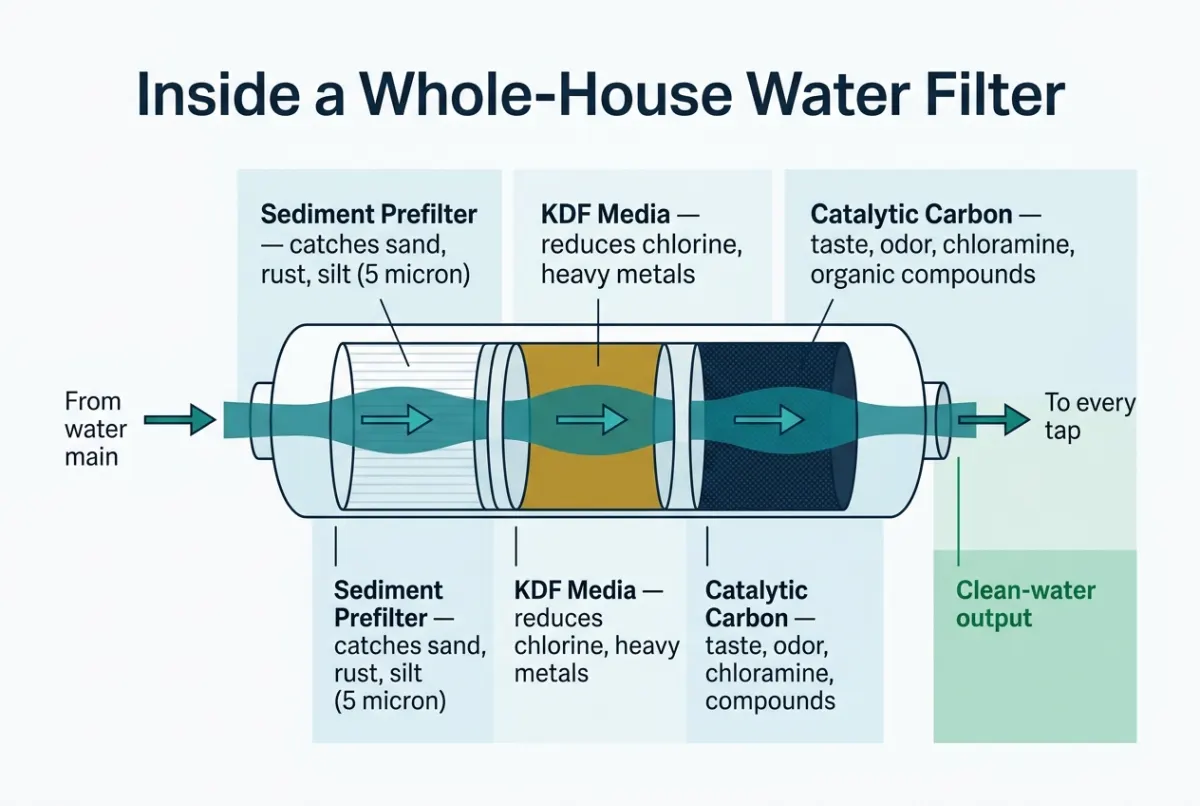
Before you buy anything: which water do you have?
A whole-house filter matched to the wrong water is an expensive tank of disappointment. City water needs chlorine and disinfection-byproduct handling — that's a carbon job, and you can do it with a long-life media tank or a lower-cost cartridge system. On a tight budget with free-chlorine city water, the cartridge route is legitimate — see our iSpring WGB32B review for the cartridge-labor-vs-media-life math.
Well water usually needs iron, sulfur, or sediment handled first, or the carbon bed fouls early. If your water comes from a well, start at the well water hub and work the symptom, not the brand. Worried about PFAS specifically? That story has a certification catch most brands gloss over — we cover it honestly here.
Beyond filtration: softening, UV, and drinking-water layers
A whole-house carbon filter solves chlorine, taste, odor, and partial PFAS reduction — but three common problems require separate equipment:
- Hard water (scale, soap film, appliance wear): requires a salt-based softener or salt-free conditioner downstream of the filter. Hardness thresholds, sizing math, and the honest difference between the two technologies: best water softener guide. For combined filter + softener installs, see the SpringWell combo review.
- Bacteria, viruses, or protozoa (confirmed positive test): requires UV disinfection installed after all other treatment stages — UV needs clear water to work. How UV dose works, when it is needed, and SpringWell add-ons vs. Viqua standalone systems: best UV water purifier guide.
- PFAS at the kitchen tap (certified reduction): whole-house catalytic carbon reduces PFAS but most systems do not carry a formal NSF P473 certification at whole-house flow rates. A certified under-sink RO provides the documented endpoint for drinking and cooking water. The Aquasana SmartFlow RO is the certified second layer in that strategy.
Why only three systems?
Because the other eleven we evaluated failed at least one of the five checkpoints in our method — capacity claims with no published media volume, "up to" flow rates that collapse at service pressure, or certification language that evaporates when you look up the actual NSF listing. A short list you can trust beats a long list that hedges. When a fourth system earns its way on, it'll be here with its math shown.
Bottom line
City water: CF1. Well water: WS1. Renting or small home: the Rhino earns a look.
Read the full CF1 verdict →Questions owners actually ask
What is the top rated whole house water filter system?
For city water the SpringWell CF1 earns the top spot on the specs that matter: 9 GPM service flow, a 1,000,000-gallon catalytic carbon media bed, and a sediment prefilter as the only recurring maintenance. For well water with iron or sulfur, the SpringWell WS1 air-injection system is the correct first move — carbon filters foul fast downstream of untreated iron.
What are the disadvantages of a whole house water filter?
Upfront cost is the main barrier: for the systems we can verify pricing on, a quality unit plus professional installation runs from about $1,300 for a light-duty city-water filter to $1,800 for a full-size carbon system. Well-water iron filters cost more, but SpringWell does not publish machine-readable pricing, so confirm that figure at springwellwater.com rather than trusting a quoted range. Whole-house filters also require dedicated installation space near the main water line, and an undersized system can reduce household water pressure noticeably. Carbon filters do not remove bacteria or hardness — those are separate problems requiring separate equipment.
What is the best whole home water filter consumer report?
Any honest evaluation compares three published numbers: service flow (GPM), media life (total gallons), and certification scope (which NSF standards cover which contaminants). The CF1 publishes 9 GPM and 1,000,000-gallon media life with component-level certifications. The Aquasana Rhino matches the media life claim but publishes ~7 GPM — a ceiling that 3-bath households will feel under concurrent demand.
What is the best water filter for E coli?
Carbon filters are not rated for bacterial removal. E. coli and coliform bacteria require UV disinfection, reverse osmosis with a certified antimicrobial stage, or both. If your water test shows coliform, install a UV system on the main line before any carbon filtration. Your state's cooperative extension lab or EPA's drinking water guidance at epa.gov can point you to certified testing and treatment options.