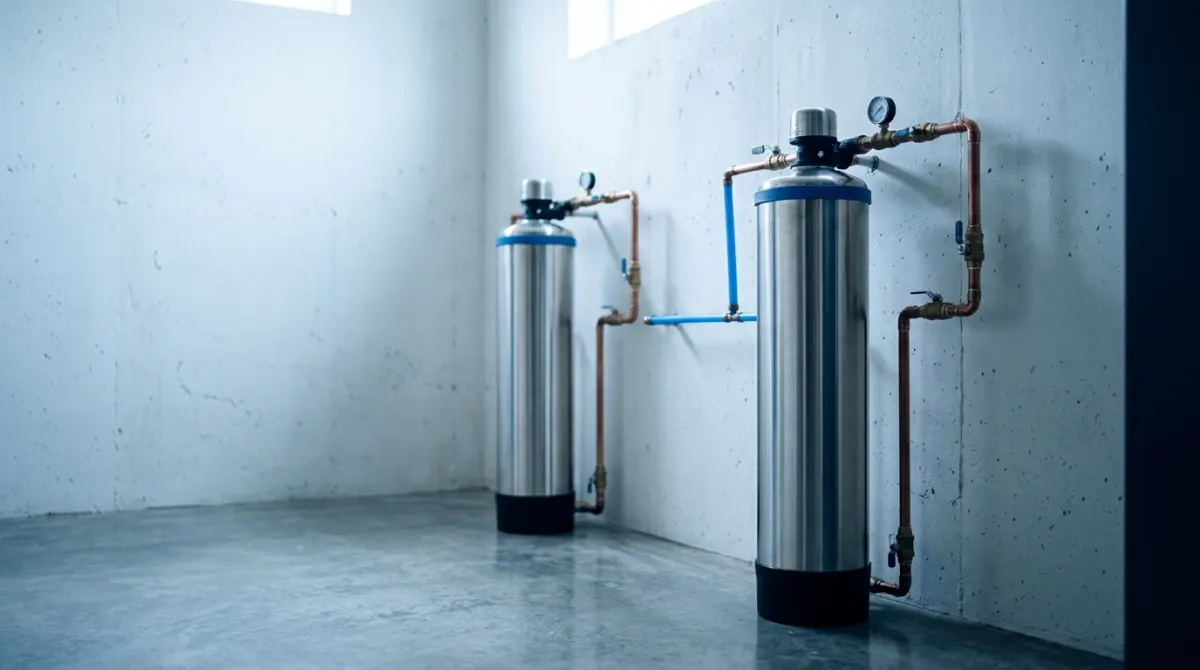
Verdict: SITUATIONAL — right for multi-contaminant well water · Score 78/100
Crystal Quest whole-house filters:
SMART series specs, GPM and installed cost
Crystal Quest's SMART series stacks more media variety than the typical whole-house carbon filter — KDF, multiple carbon types, and specialty stages in one tank. The honest picture: a legitimate system for complex water, with the tradeoffs of a smaller brand.
By Tim Parker — Reads the spec sheets and prices the full install
What Crystal Quest is
Crystal Quest is a water filtration manufacturer with a broader product catalog than most direct-to-consumer brands — whole-house filters, under-sink systems, commercial equipment, and specialty media for specific contaminants. Their core residential whole-house product is the SMART series — multi-stage whole-house systems that combine different media types in a single tank or multi-tank configuration.
The SMART line is available in multiple sizes. Based on Crystal Quest's published product information, the standard SMART whole-house filter is sized for 9–13 GPM service flow for 4–6 people, starting at approximately $1,791 for the base configuration. Larger multi-tank configurations for higher flow demands are available. Verify current pricing and configurations at crystalquest.com, as product lines are updated periodically.
We earn nothing if you buy through this link — the manufacturer sells it directly and we are not in their programme.
The multi-media approach: what it targets
Where the SpringWell CF1 uses a catalytic carbon + KDF combination in its ActivFlo tank, Crystal Quest's SMART systems layer multiple distinct media types to cover a broader contaminant profile. Their published media descriptions include granular activated carbon (GAC), KDF-55, KDF-85, and in some configurations Eagle Redox Alloy media designed specifically for heavy metal reduction.
| Media type | Primary targets | Notes |
|---|---|---|
| KDF-55 | Chlorine, hydrogen sulfide, heavy metals (lead, mercury, copper) | Electrochemical process; effective at higher flow rates than carbon alone |
| KDF-85 | Iron (ferrous), hydrogen sulfide, chlorine | Specifically formulated for iron reduction — useful for light iron in well water |
| Granular activated carbon (GAC) | Chlorine, VOCs, taste, odor, herbicides, pesticides | Standard carbon; lower chloramine efficacy than catalytic carbon |
| Eagle Redox Alloy (in some configurations) | Heavy metals, microorganisms (bacteriostatic) | Per Crystal Quest published specs; confirm current media configuration for your model |
Specific media combinations vary by Crystal Quest model and configuration year. Confirm the exact media stages in the current model you are evaluating at crystalquest.com before purchasing.
How it compares to the SpringWell CF1
| Spec | Crystal Quest SMART | SpringWell CF1 |
|---|---|---|
| Service flow | 9–13 GPM (standard configuration) | 9 GPM (1–3 bath size); 12+ GPM larger sizes |
| Household sizing | 4–6 people (standard) | 1–3 bath (standard); larger sizes available |
| Media variety | Multiple types: KDF-55, KDF-85, GAC, specialty alloy | Catalytic carbon + KDF (two primary media types) |
| Catalytic carbon (chloramine) | GAC in base config — lower chloramine efficacy than catalytic carbon | Catalytic carbon — better chloramine reduction |
| Typical street price (system only) | From ~$1,791 (per published pricing) | $1,170 |
| Brand documentation / community | Smaller owner community, fewer DIY resources online | Larger DIY community, more install documentation |
| NSF certification scope | Verify current certifications at crystalquest.com | Component-level certifications; system not NSF-listed |
Where Crystal Quest wins
The SMART system's multi-media design makes it a more natural fit for well water with moderate ironthat doesn't quite warrant the full air-injection approach of the WS1, or for city water with heavy metal concerns beyond what a carbon-only system addresses. The KDF-85 stage handles light ferrous iron — useful for wells with iron in the 0.1–0.5 ppm range where an air-injection system is overbuilt. The heavy metal reduction profile is broader than a pure carbon system.
Crystal Quest also offers specialty configurations that aren't in the direct-to-consumer mainstream: fluoride removal, tannin removal, nitrate reduction. If your water test shows a specific contaminant beyond the standard chlorine/iron profile, Crystal Quest's catalog depth is a genuine advantage.
The honest tradeoffs
Smaller brand footprint.SpringWell and Aquasana have invested heavily in consumer-facing documentation: install videos, online owner communities, responsive support. Crystal Quest's support infrastructure is functional but less built out for the DIY installer. Plan to use a licensed plumber rather than attempting a self-install without prior whole-house filter experience.
Chloramine performance caveat.If your city water uses chloramine rather than chlorine (check your utility's CCR — many utilities switched in the last decade), the standard GAC media in Crystal Quest's base SMART configuration is less effective than catalytic carbon at chloramine reduction. Confirm whether a catalytic carbon upgrade is available for your configuration before purchasing on a chloramine-treated water supply.
Media life documentation.Crystal Quest's published media life figures should be verified at crystalquest.com for the specific model you are considering. Media life varies by configuration and water chemistry — the same spec-checking exercise applies here as with any whole-house system.
Verdict — 78/100
SITUATIONAL: right for multi-contaminant well water or specific heavy metal concerns. For straightforward city water with chlorine and chloramine, the SpringWell CF1's catalytic carbon is a better fit.
Compare against the top pick for city water: SpringWell CF1 review. For well water with iron above 1 ppm, the air-injection approach is more reliable: SpringWell WS1 review.
Questions owners actually ask
How many stages should a whole house water filter have?
The number of stages matters less than what each stage does. A two-stage system with a sediment prefilter and a high-volume catalytic carbon bed can outperform a six-stage system where four stages are redundant. That said, multi-stage systems with different media types — KDF, granular activated carbon, catalytic carbon, ion exchange — address a broader contaminant spectrum and can be appropriate for well water or problem water sources with multiple contaminants. Evaluate each stage's purpose against your water test results, not against competitor stage counts.
Is Crystal Quest a good water filter brand?
Crystal Quest is an established water filtration manufacturer with a broader product range than most direct-to-consumer brands. Their SMART series uses a multi-media design with more media variety than the typical carbon-only whole-house filter. The honest tradeoff: Crystal Quest has a smaller brand footprint than SpringWell or Aquasana in direct-to-consumer marketing, which means fewer owner reviews, less online installation documentation, and a smaller community of DIY installer experiences to draw on. For buyers who want a multi-media system and are comfortable with professional installation, Crystal Quest is a legitimate option worth evaluating against their published specs.
What is the difference between whole house water filter stages?
Different filter media target different contaminants. Sediment filters remove particulates, sand, and rust mechanically. KDF (kinetic degradation fluxion) media uses a copper-zinc alloy to remove chlorine, heavy metals including lead and mercury, and hydrogen sulfide through electrochemical reaction. Granular activated carbon (GAC) removes chlorine, VOCs, taste, and odor through adsorption. Catalytic carbon upgrades GAC's performance specifically on chloramine, which standard carbon handles poorly. Ion exchange resin removes heavy metals and can soften water. Multi-stage systems layer these media to address multiple contaminant categories simultaneously.
Do whole house water filters reduce water pressure?
A correctly sized whole-house filter on clean media produces minimal pressure drop — typically 5–10 PSI at service flow rates, which most households do not notice. Pressure drop increases as media loads with sediment or as flow demand exceeds the system's rated GPM. An undersized system (wrong GPM rating for the household) produces noticeable pressure drops at peak demand. A sediment prefilter that has gone too long between changes will also cause pressure drop as it loads up — this is the most common cause of pressure complaints in online owner discussions. Change the prefilter on schedule.
We earn nothing if you buy through this link — the manufacturer sells it directly and we are not in their programme.